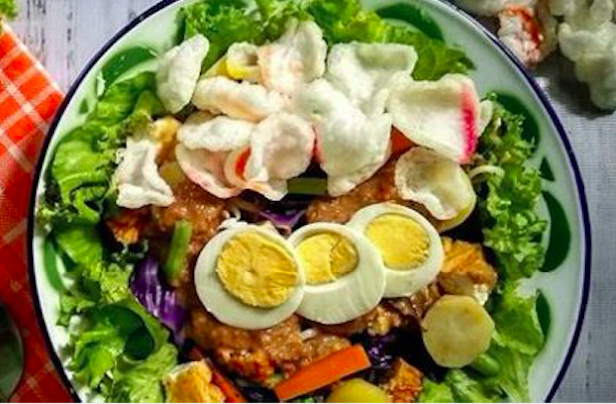
There are many versions of Indonesian vegetable salads. They are usually vegetarian, mostly vegan, and all have a mixture of veggies, salad, proteins and carbs, served with a peanut sauce. They are often served with Indonesian crackers on the side. The sauce can either be stirred through the vegetables or served on the side. In Indonesia, every restaurant or street food vendor serves their own versions, and they also vary regionally throughout Indonesia as they have been adapted to local tastes and available vegetables. Most are thought to have originated in the West Java/Banten (Sundanese) area around Jakarta.
They are great one-dish vegetarian meals as they contain protein from the peanuts in the sauce, as well as tofu or tempeh, and as much vegetable as you want to add.
The common versions are:
- Gado-gado – the most well known internationally. Gado-Gado is a mixture of steamed veggies, salad, tofu, tempeh and peanut sauce.
- Karedok – this version usually has only raw vegetables and salad.
- Ketoprak – contains rice noodles and rice cake, always tofu and not tempeh, and less vegetables.
- Pecel – thought to originate from East Java, pecel does not contain any tofu or tempeh.
Basic Peanut Sauce
Peanut sauce is the common ingredient to all these dishes. To make the peanut sauce simply combine the following ingredients. The sauce can be eaten cold, but is usually warmed up to serve.
- 3 tbsp peanut butter
- 3-4 tbsp coconut milk and/or water
- 1 clove garlic
- Chilli to your taste
- 2 tbsp lime juice
- 3 tbsp kecap manis
Kecap Manis is Indonesian sweet soy sauce which contains palm sugar. If you don’t have it use 2 1/2 tbsp soy sauce and 1/2 tbsp of honey, maple syrup, or sugar instead. If you want to stick with the Indonesian theme try some palm sugar or coconut sugar.
Some recipes have less coconut milk and more water instead. You can adjust this to suit how rich you want the sauce to be. Usually the sauce would be runnier than a satay sauce, but thicker than a gravy, with a consistency like a cheese sauce. Some recipes also contain tamarind paste, but this is not essential.
Gado-Gado
Gado-Gado is served on a bed of lettuce, and always contains steamed vegetables with fried tofu and/or tempeh chunks on top, often both, and also served with a hard boiled egg.
To prepare gado-gado (and all the other salads) put the salad and cooked vegetables on the plate and pour the peanut sauce over them, add the tofu/tempeh/egg on top, and serve. If you want to be fancy, sprinkle on chopped coriander leaves and finely chopped peanut. It can be eaten with rice, but more often is served just with Indonesian crackers (see below).
There are no hard and fast rules, on what vegetables go into gado-gado but below are the typical ingredients.
- Cubes of a boiled starchy vegetable often jack fruit, potato or sweet potato
- Steamed green beans
- Beansprouts, cooked or raw
- At least one wilted leafy green – spinach, kale, cabbage or similar
- Fried firm tofu and/or tempeh cubes (see my other posts)
- Hard boiled egg (omit for a vegan version)
- Lettuce
- Peanut sauce
- Coriander and chopped peanuts (optional to serve)
Some western versions also add thinly sliced red or green pepper, or carrot, but these are not commonly used in Indonesia. I have also seen versions, with more salad ingredients, such as tomato and cucumber, and less veggies. Gado-Gado is very flexible, cook it with whatever you have in the fridge!
Karedok
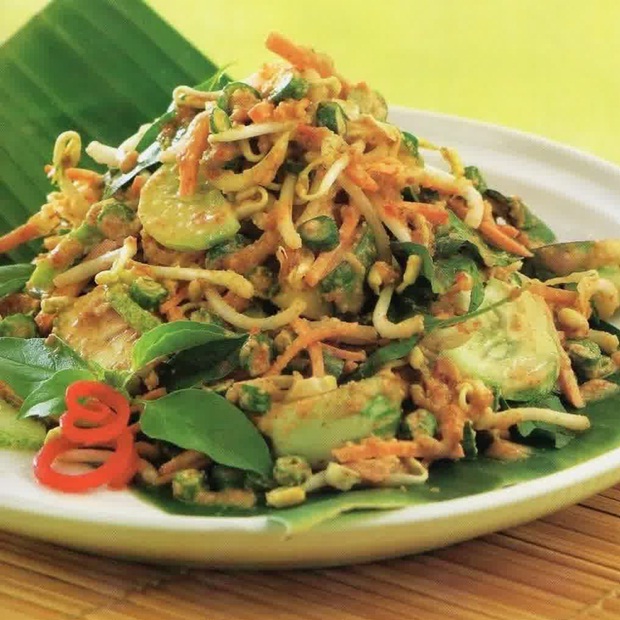
Karedok has 2 main differences from gado-gado: firstly the vegetables are served raw, and secondly the peanut sauce has an addition of kencur, an Indonesian spice similar to galangal. Typical karedok ingredients are:
- Green beans, chopped into small pieces
- Shredded cabbage
- Aubergine, cut into small pieces
- Beansprouts
- Cucumber, sliced or cubed
- Basil leaves
- Fried tofu and/or tempeh cubes (see my other posts)
- Peanut sauce, as per the basic sauce but with kencur or galangal added.
Again sometimes karedok is served with rice, but more commonly with Indonesian crackers.
Ketoprak
Ketoprak has more carbs and less vegetables than the other dishes. It usually contains vermicelli (rice) noodles and steamed rice cake (lontong). Lontong is cooked rice pressed into a cake, and left to cool with some weight on top, so it can be sliced or cubed when cool, and is often served cold. Ketoprak always has freshly fried tofu and fried shallots on the top. The peanut sauce for ketoprak is usually more garlicky than for gado-gado.
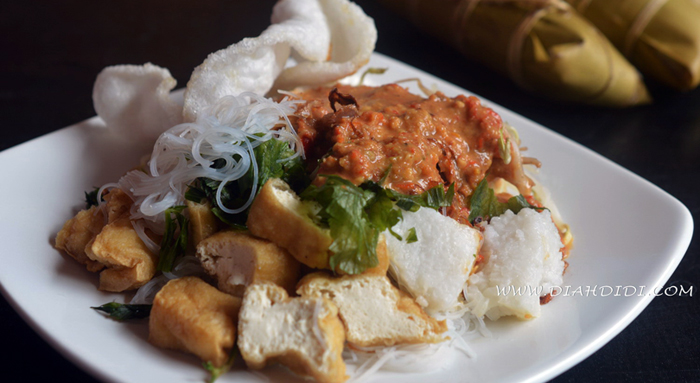
Typical ketoprak ingredients are:
- Rice noodles and optionally rice cake (lontong)
- Wilted cabbage or leafy greens
- Beansprouts, cooked or raw
- Cucumber, sliced or cubed
- Fried tofu cubes
- Fried shallots
- Peanut sauce, as per basic sauce but with additional garlic
- Drizzle on Kecap Manis to serve
Pecel
Pecel is from East Java. It does not contain carbs or tofu or tempeh, so is more of a vegetable side dish, than a meal-in-one. Pecel ingredients are:
- Steamed green beans, chopped into small pieces
- Shredded steamed cabbage
- Beansprouts, cooked or raw
- Cucumber, sliced or cubed
- A wilted leafy green – spinach, kale, cabbage or similar
- Peanut sauce, as per basic sauce but with kencur or galangal added.
Indonesian Crackers

Indonesian crackers come in a huge variety of shapes, sizes and flavours and are sold on every street corner. Large crackers are 10-15cm diameter and are called krupuk. They are made from various starch flours (rice, tapioca, cassava etc), dried into a cake, sometimes with flavourings such as shrimp, fish or garlic, and then deep fried. For vegetarians, it is sometimes hard to pick which crackers do not contain any fish products. The krupuk blek or krupuk kampung is made from cassava starch and is most commonly served with gado-gado. The most internationally known krupuk is krupuk udang – prawn crackers. To serve an authentic Indonesian vegetable salad, always add crackers on the side to add a bit of crunch to the meal.
So there you have it, Indonesian vegetable salads are quick and easy to make, really flexible in the ingredients, healthy and super delicious. Give them a go, and soon you’ll be eating them all the time.
 Letter from Jakarta.