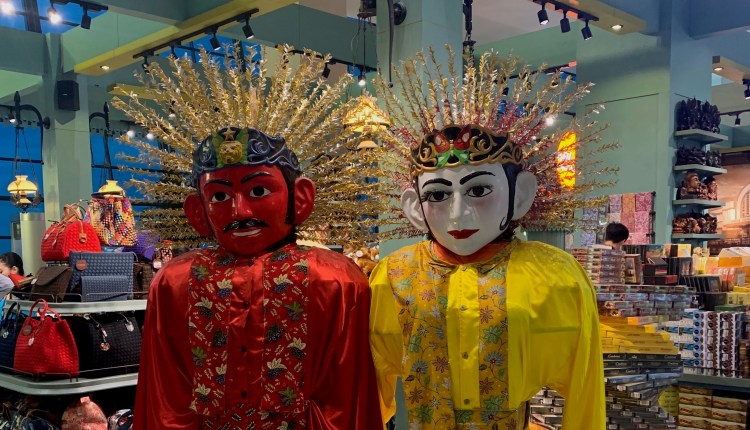
Maybe you have been wondering who the fine fellows on my home page are? They are Ondel-Ondel, a striking feature of Jakarta street scenes. This style of puppet is very particular to Jakarta, and so they have become a sort of un-official Jakarta mascot.
Ondel-ondel are 2.5 to 3m high puppets, made from a bamboo frame and a head carved from wood. There are always two puppets, a male with a red face, and a female with a white face. Each puppet has a person inside who dances, or at least sort of bobs and twirls, to traditional music, either from a small band, or from a speaker pushed on a cart. The troupe also always comprises one or two scruffy urchins (because thats what they always seem to be) who harass passers-by into a donation, and are especially tenacious with westerners.
The ondel-ondel are a feature of Betawi culture, and have their roots in the traditional Barongan figures, who are protective spirits that protect homes and villages against disasters and evil spirits. Barongan spirits are a feature in several Indonesian cultures, and are thought to have developed from the animistic Austronesian cultures, long before Hinduism or Chinese influences arrived in Indonesia. It is still common today for ondel-ondel makers to make offerings before they start a new puppet to ensure it is endowed with benevolent spirits, and ondel-ondel performers will frequently be invited to attend important occasions such as weddings, to protect the guests from evil spirits.
The first modern record of ondel-ondel were observations by a British merchant in 1605. During Batavia’s early years, the ondel-ondel had a scarier appearance with large fangs and goggle-eyes, and would often ask for opium or cigars instead of money. This scarier, more animist, form of ondel-ondel/barongan is still found in Bali. It is not clear when Jakarta’s ondel-ondel evolved into their current form.
The Betawi culture, is specific to the Jakarta area and is distinct from the Sundanese and Javan cultures and peoples who dominate the rest of Java. The Betawi people (Orang Betawi, meaning “people of Batavia”), are one of the youngest ethnic groups in Indonesia, emerging only in the 18th century as a distinct group, and formed from the various local and immigrant groups living in the city. The cultures that have influenced Betawi include those from all over the 17,000 islands of the Indonesian archipelago and also Malays, Chinese, Arabs, Indians, Portuguese and Dutch. The 1930 census was the first to formally acknowledge Betwai as a distinct ethnic group.
Today’s ondel-ondel, tour the streets and suburbs of Jakarta looking to make a living from donations. They regularly wander past my office windows in the late afternoon, and add a street carnival atmosphere to Car-Free Day. Some in Jakarta see them as street theatre and enjoy the spectacle as they bob along the streets. To others they are more of an urban nuisance, and seen as nothing more than beggars and a traffic hazard. In February 2020, the Jakarta government mooted the idea of banning them from the streets, but this has not been enacted as yet. Whilst they can be a bit over zealous in hassling for money, they are a lively addition to Jakarta’s traffic clogged streets, and I hope a way forward can be found that includes a place for Jakarta’s crazy icon.
 Letter from Jakarta.